
Language Models · Sequence Modeling
Language Models Need Sleep: A Consolidate-and-Dream Recipe
Google Research argues LLMs need an offline sleep phase to turn short-term context into stable weights. With sleep, Qwen3-8B hits 79.2% on AIME-24 and a Transformer reaches 80% on ARC few-shot, beating SEAL.
Quick answer
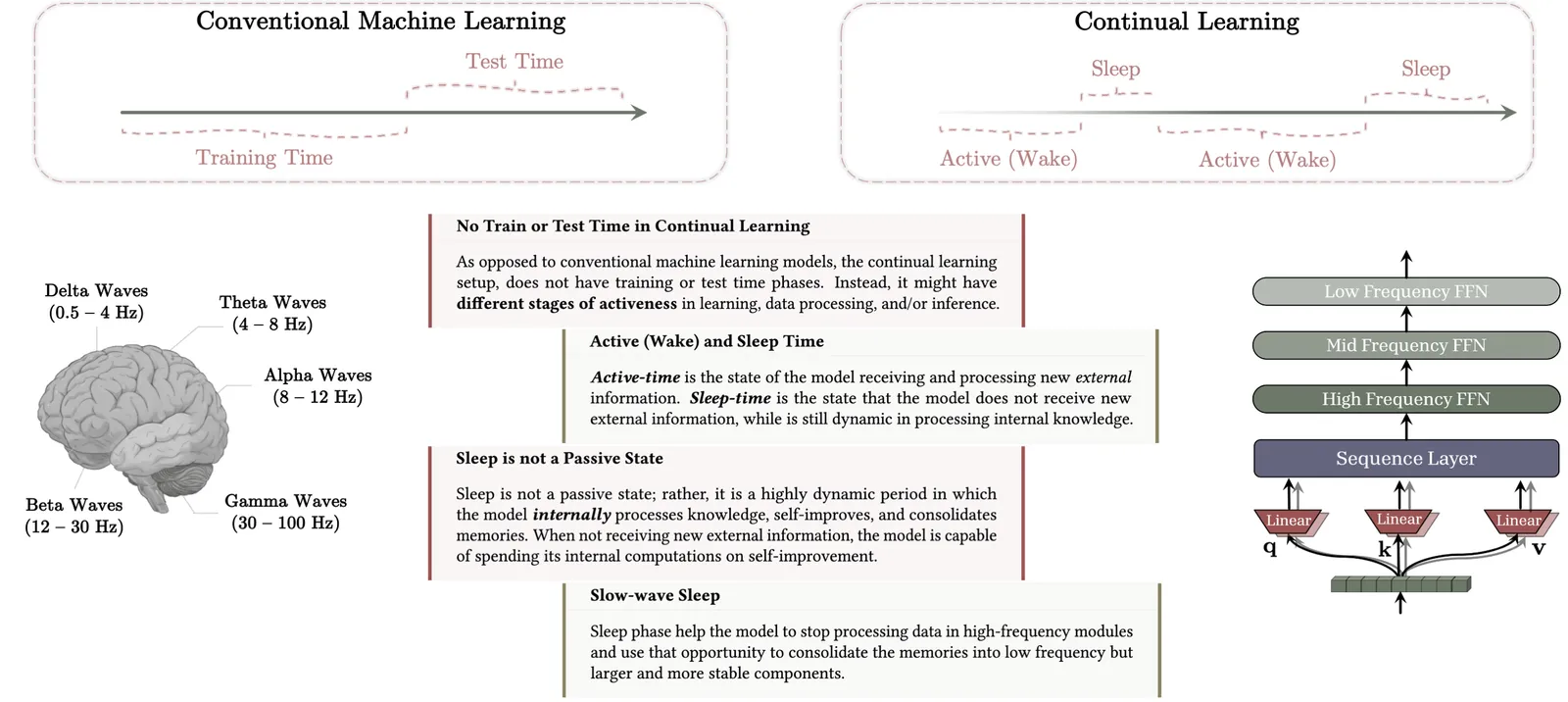
Google Research argues a language model should not learn only while answering — it needs an offline “sleep” phase that rewrites its own weights, the same way humans consolidate the day’s experience overnight. Their two-stage recipe takes short-term context picked up during the “wake” phase and converts it into durable parameters: a Consolidation stage distills new knowledge into the network, then a Dreaming stage uses reinforcement learning to generate synthetic practice data and self-improve with no human supervision. With sleep added, Qwen3-8B reaches 79.2% on AIME-24 and a Transformer hits 80% success on ARC few-shot tasks, versus 72.5% for the SEAL self-editing baseline and 10% for test-time training.
The problem: in-context learning forgets
A model handling a long conversation or document holds new facts only in its activations and context window. The paper’s framing is blunt: this kind of online learning is “selective and retrieval-dependent” — it works while the relevant text sits in context, then evaporates. Nothing is written back to the weights, so the next session starts from scratch. The authors map this onto a biological analogy: the wake phase gathers experience cheaply but unreliably, and a separate offline phase is needed to commit anything to long-term memory. The claim is that “this form of consolidation is not enough for robust continual learning” on its own.
The method: consolidate, then dream
Sleep runs in two stages. Consolidation does Knowledge Seeding via what the authors call upward distillation: a smaller, faster model that absorbed recent context teaches a larger network, combining Generalized Knowledge Distillation (GKD) with an RL-based Learning-to-Imitate objective. The parameter count is expanded to make room for new knowledge without overwriting old skills. Dreaming is the self-improvement half: the model generates its own synthetic training data, scores candidate “dreams” by gradient-based importance, and injects novelty through controlled expert randomization. The two-step split is deliberate — the paper notes that “iteratively applying self-improvement in continual learning setup might cause catastrophic forgetting,” so consolidation and dreaming are kept as distinct phases rather than fused into one update loop.
Why now: continual learning hits a wall
Test-time training and self-editing methods like SEAL have made offline self-modification a live research area, but each handles only a slice — either adapting to one task or memorizing one passage. This work tries to unify long-horizon memory, continual learning, knowledge incorporation, and few-shot generalization under a single sleep schedule, and pairs it with a multi-frequency memory architecture the authors call Hope, where different parameter groups update at different rates across sleep cycles.
Key results
- Few-shot ARC. With sleep, a Transformer reaches 80% success, against 72.5% for SEAL, 10% for test-time training (TTT), and 0% for in-context learning.
- Math reasoning. Qwen3-8B with sleep scores 79.2% on AIME-24, 69.0% on AIME-25, and 46.1% on HMMT-25. Qwen3-1.7B with sleep scores 53.2%, 40.2%, and 29.3% on the same three. Against the OPSD baseline, sleep adds +2.6% on AIME-24 for the 8B model.
- Knowledge incorporation (SQuAD). Sleep with a four-level memory reaches 48.9% on a single passage and 46.2% at n=200 passages, versus 46.7% and 43.2% for SEAL.
- Long-context memory. The Hope architecture holds near-perfect retrieval scaling to 10M tokens on BABILong, where Titans and ARMT degrade sharply beyond 1M tokens.
- Continual translation (CTNL). Hope recovers nearly single-language performance after sequential exposure to multiple languages; in-context learning drops sharply in the same setup.
A consistent theme: accuracy on long-context tasks (MK-NIAH, LongHealth, QASPER) improves monotonically as more consolidation stages are added.
Limits and open questions
The numbers are real but the framing leans hard on a brain metaphor, and the paper itself flags the central risk: repeated self-modification invites catastrophic forgetting, which the two-stage design mitigates rather than solves. The strongest long-context and continual-learning results ride on the custom Hope architecture, so it is not yet clear how much of the gain comes from the sleep schedule versus the architecture underneath it. The math gains are modest — +2.6% on AIME-24 over OPSD is a real but narrow margin. And the abstract page lists no compute cost or wall-clock overhead for running a sleep cycle, so the practicality of doing this between deployments is unestablished. Whether “dreaming” on self-generated data avoids drift over many cycles is the open question that matters most.
FAQ
What is the Sleep paradigm for language models?
It is a two-stage offline process from Google Research that lets an LLM rewrite its own weights between sessions: a Consolidation stage distills recent context into the network, and a Dreaming stage uses RL on self-generated synthetic data to self-improve without human labels.
Does the Sleep method beat SEAL?
On the benchmarks reported, yes. It reaches 80% on ARC few-shot versus SEAL’s 72.5%, and 48.9% versus 46.7% on single-passage SQuAD knowledge incorporation.
What is the difference between consolidation and dreaming?
Consolidation transfers freshly learned context into stable weights via upward distillation; dreaming generates synthetic practice data and self-improves on it. They are split into separate phases to limit catastrophic forgetting.
Who wrote Language Models Need Sleep?
Ali Behrouz, Farnoosh Hashemi, and Vahab Mirrokni at Google Research, posted to arXiv as 2606.03979 on June 2, 2026.