
Speech Recognition · Fine-Tuning & Adaptation · Self-Supervised Learning
Mega-ASR: Scaling Acoustic Simulation for In-the-Wild Speech Recognition
Mega-ASR fights ASR's noise-robustness gap by synthesizing 2.4M clips across 54 compound acoustic scenarios, then training Qwen3-ASR-1.7B in two stages — cutting WER to 45.69% vs 54.01% on VOiCES R4-B-F.
Quick answer
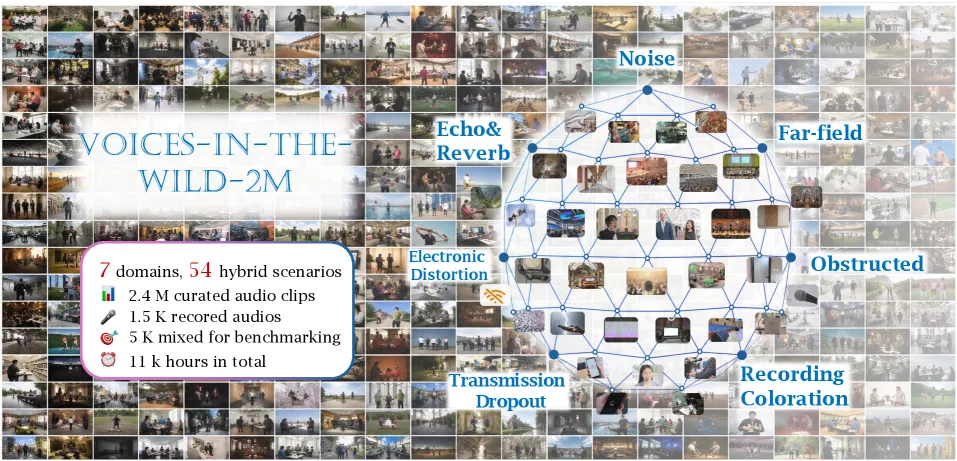
Mega-ASR attacks the part of speech recognition that still fails in the real world: heavily degraded audio. Instead of collecting more clean data, the authors build Voices-in-the-Wild-2M — 2.4M synthesized clips and 11k hours covering 7 classic acoustic effects and 54 physically plausible compound scenarios — then fine-tune Qwen3-ASR-1.7B on it in two stages. On the adverse-condition benchmarks the headline gain is a drop in word error rate (WER) to 45.69% vs 54.01% on VOiCES R4-B-F and 21.49% vs 29.34% on NOIZEUS Sta-0 against prior state-of-the-art systems, with over 30% relative WER reduction reported on the hardest compound conditions.
The problem: ASR is solved on clean speech, not on real rooms
Modern ASR is near-saturated on clean read speech — error rates on LibriSpeech sit around 1-3% — yet the same models degrade sharply under far-field capture, reverberation, codec artifacts, and packet loss. The paper frames this as an “in-the-wild squared” gap: not one nuisance at a time, but several stacked at once, which is what actually happens on a phone call from a noisy street. The bottleneck the authors identify is data, not architecture: there is no large, controlled corpus that systematically covers compound degradations, so models never learn to recover from them.
What is in Voices-in-the-Wild-2M
The dataset is the real contribution. It defines 7 base acoustic phenomena — noise, far-field, obstruction, echo and reverb, recording coloration, electronic distortion, and transmission dropout — and composes them into 54 physically plausible combinations rather than random mixes. The pipeline simulates these effects on clean source speech to produce 2.4M curated clips totaling roughly 11k hours, spanning English and Mandarin. For evaluation the authors carve out Voices-in-the-Wild-Bench, a 5,000-clip set that deliberately mixes 3,500 synthetic clips with 1,500 real-world recordings, so a model cannot win just by overfitting the simulator.
The honest judgment here: the headline scale is synthetic. Simulated reverb and codec loss are physically grounded, but they are still a model of the world, and the 1.5k real recordings exist precisely because the authors know synthetic-to-real transfer is the thing reviewers will doubt.
How the two-stage training works
Mega-ASR does not train from scratch — it adapts Qwen3-ASR-1.7B, an existing 1.7B-parameter ASR model, in two stages:
- A2S-SFT (Acoustic-to-Semantic Progressive Supervised Fine-Tuning): a curriculum that orders examples by difficulty using WER thresholds, so the model first learns easy degradations and progressively faces harder compound scenarios. The “acoustic-to-semantic” framing is the point — early training stabilizes acoustic decoding, later training pushes semantic recovery when the signal is too damaged to transcribe phonetically.
- DG-WGPO (Dual-Granularity WER-Gated Policy Optimization): a reinforcement-learning stage with a reward that is gated by WER and combines two granularities (utterance-level and a finer token/word level). Gating on WER means the policy is only rewarded when transcription quality actually improves, which is meant to stop the usual RL failure mode of optimizing a proxy that drifts from real accuracy.
Key results
- VOiCES R4-B-F: 45.69% WER vs 54.01% for the prior state-of-the-art system — the paper’s headline adverse-condition number.
- NOIZEUS Sta-0: 21.49% vs 29.34%, again beating the prior SOTA on stationary-noise speech.
- Compound scenarios: over 30% relative WER reduction on the hardest stacked-degradation conditions.
- Scale: 2.4M synthesized clips, ~11k hours, 7 base phenomena, 54 compound scenarios; a 5,000-clip benchmark (3,500 synthetic + 1,500 real).
- Base model: Qwen3-ASR-1.7B, so the gains come from data and training, not a larger backbone.
All numbers above are taken from the paper’s abstract and HTML; the VOiCES and NOIZEUS figures are the SOTA comparisons the authors lead with.
Limits and open questions
The central risk is generalization from simulation. A 2.4M-clip corpus is impressive, but most of it is synthetic, and the small real-recording slice cannot fully prove that gains transfer to arbitrary unseen rooms, devices, and codecs. Second, the benchmarks are degradation-focused — strong VOiCES and NOIZEUS numbers do not guarantee the model stays competitive on clean LibriSpeech-style audio, where the prior model was already strong and there is little room to improve. Third, the two-stage recipe (curriculum SFT plus WER-gated RL) adds real training complexity, and the paper’s value depends on whether that pipeline reproduces outside the authors’ setup. Finally, “54 compound scenarios” is a designed taxonomy, not the true long tail of real-world acoustics; coverage of those 54 is not the same as coverage of the wild.
FAQ
What is Mega-ASR?
Mega-ASR is a speech-recognition system built to handle severely degraded, real-world audio. It pairs a 2.4M-clip synthetic dataset (Voices-in-the-Wild-2M) with a two-stage fine-tune of Qwen3-ASR-1.7B, and reports lower WER than prior state-of-the-art on noisy benchmarks like VOiCES and NOIZEUS.
How much does Mega-ASR improve word error rate?
On VOiCES R4-B-F it reaches 45.69% WER versus 54.01% for the prior best system, and on NOIZEUS Sta-0 it reaches 21.49% versus 29.34%. The paper also reports over 30% relative WER reduction on the hardest compound-degradation conditions.
What is the Voices-in-the-Wild-2M dataset?
It is a simulated corpus of 2.4M clips and about 11k hours covering 7 classic acoustic phenomena (noise, far-field, obstruction, echo and reverb, recording coloration, electronic distortion, transmission dropout) composed into 54 physically plausible compound scenarios, in English and Mandarin.
What are A2S-SFT and DG-WGPO in Mega-ASR?
A2S-SFT is a difficulty-ordered supervised fine-tuning curriculum that moves from acoustic to semantic recovery; DG-WGPO is a WER-gated reinforcement-learning stage combining utterance- and word-level rewards so the policy is only credited when transcription accuracy actually rises.
Should I use Mega-ASR over a general ASR model?
If your audio is clean, a general model is fine. Mega-ASR is targeted at adverse conditions — far-field, reverberant, lossy, or stacked degradations — where its training data is designed to help, and where it shows its largest WER gains.
One line: scale the hard data, not just more clean data, and a 1.7B ASR model recovers far better from real-world noise. Read the original paper on arXiv.